Fifty agent startups in one building: notes from Agentic Summit BLR
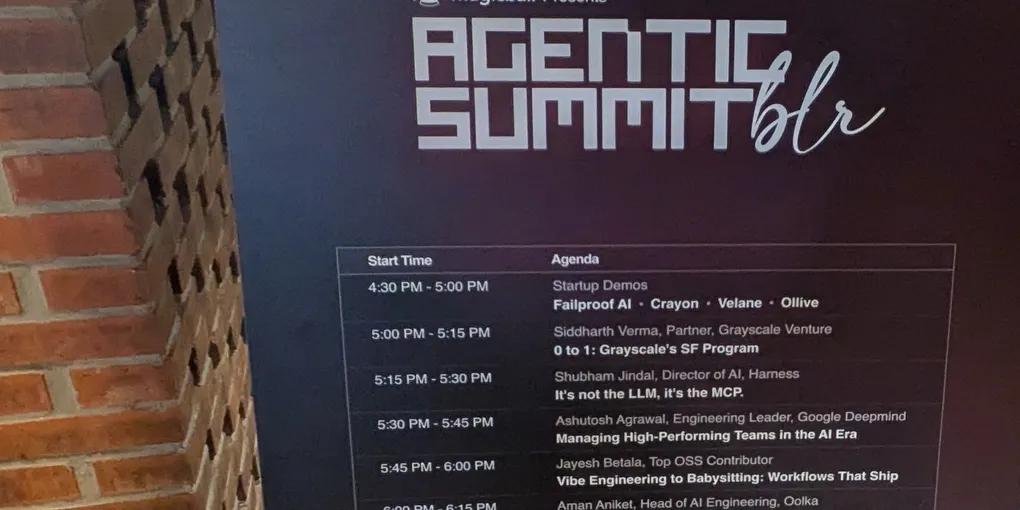
Magicball ran Agentic Summit BLR on Wednesday at the Bangalore International Centre. Roughly fifty AI startups, two floors, four hours of demos, and a booth floor that stayed packed until they turned the lights up.
I went with a specific goal: not to network, but to write down what every single company on the floor actually does. Booth signage is the most honest artefact at any conference. Nobody puts a vague slogan on a ₹8,000 roll-up banner — they put the one sentence they think will make a stranger stop walking.
So I photographed all of them. Here’s the catalogue.
The schedule
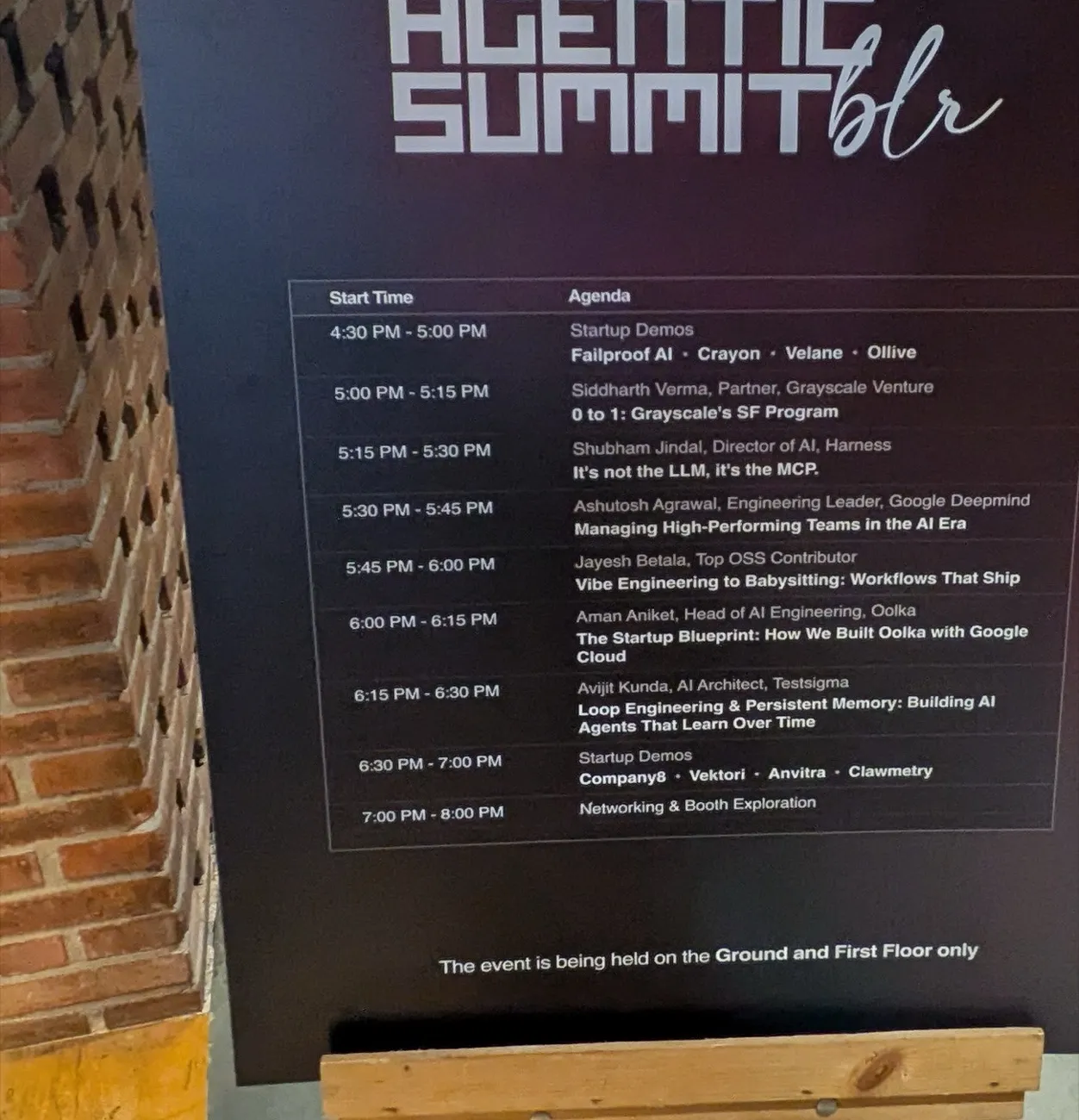
Two demo blocks bookending seven talks. The talk titles were better than most:
- Shubham Jindal (Director of AI, Harness) — It’s not the LLM, it’s the MCP.
- Ashutosh Agrawal (Engineering Leader, Google DeepMind) — Managing High-Performing Teams in the AI Era
- Jayesh Betala (Top OSS Contributor) — Vibe Engineering to Babysitting: Workflows That Ship
- Aman Aniket (Head of AI Engineering, Oolka) — The Startup Blueprint: How We Built Oolka with Google Cloud
- Avijit Kunda (AI Architect, Testsigma) — Loop Engineering & Persistent Memory: Building AI Agents That Learn Over Time
- Siddharth Verma (Partner, Grayscale Ventures) — 0 to 1: Grayscale’s SF Program — more on this below
Sponsors were Google Cloud, Testsigma and Grayscale Ventures.
The floor
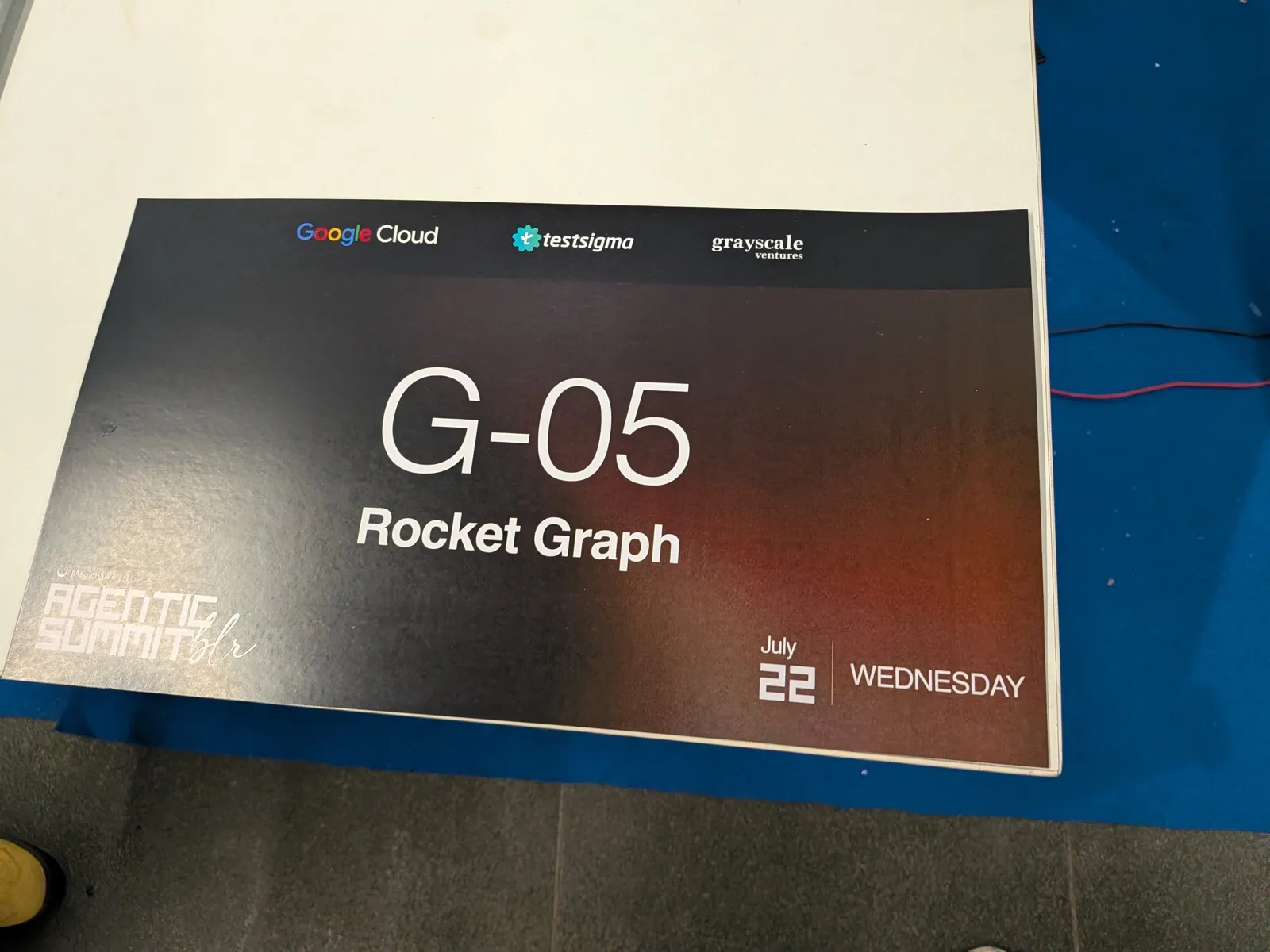
Every booth got a printed placard with a grid reference — G-05, F-17 — which turned out to be the most useful thing at the event. It meant I could photograph a table and know exactly whose table it was, even when the founder was mid-demo and I didn’t want to interrupt.
Every startup I catalogued
Everything in the “what it does” column comes from the company’s own banner, placard or demo screen, or from the organisers’ post-event email. Where I couldn’t read a URL off the signage, the website cell is blank rather than guessed.
| Company | What it does | Why it’s interesting | Website |
|---|---|---|---|
| Failproof AI | An end-to-end failure layer for AI agents: observe → identify → write policy → enforce. | The only company there selling failure rather than capability. Their booth ran a live leaderboard of people trying to break agents, which is a much better demo than a dashboard screenshot. | befailproof.ai |
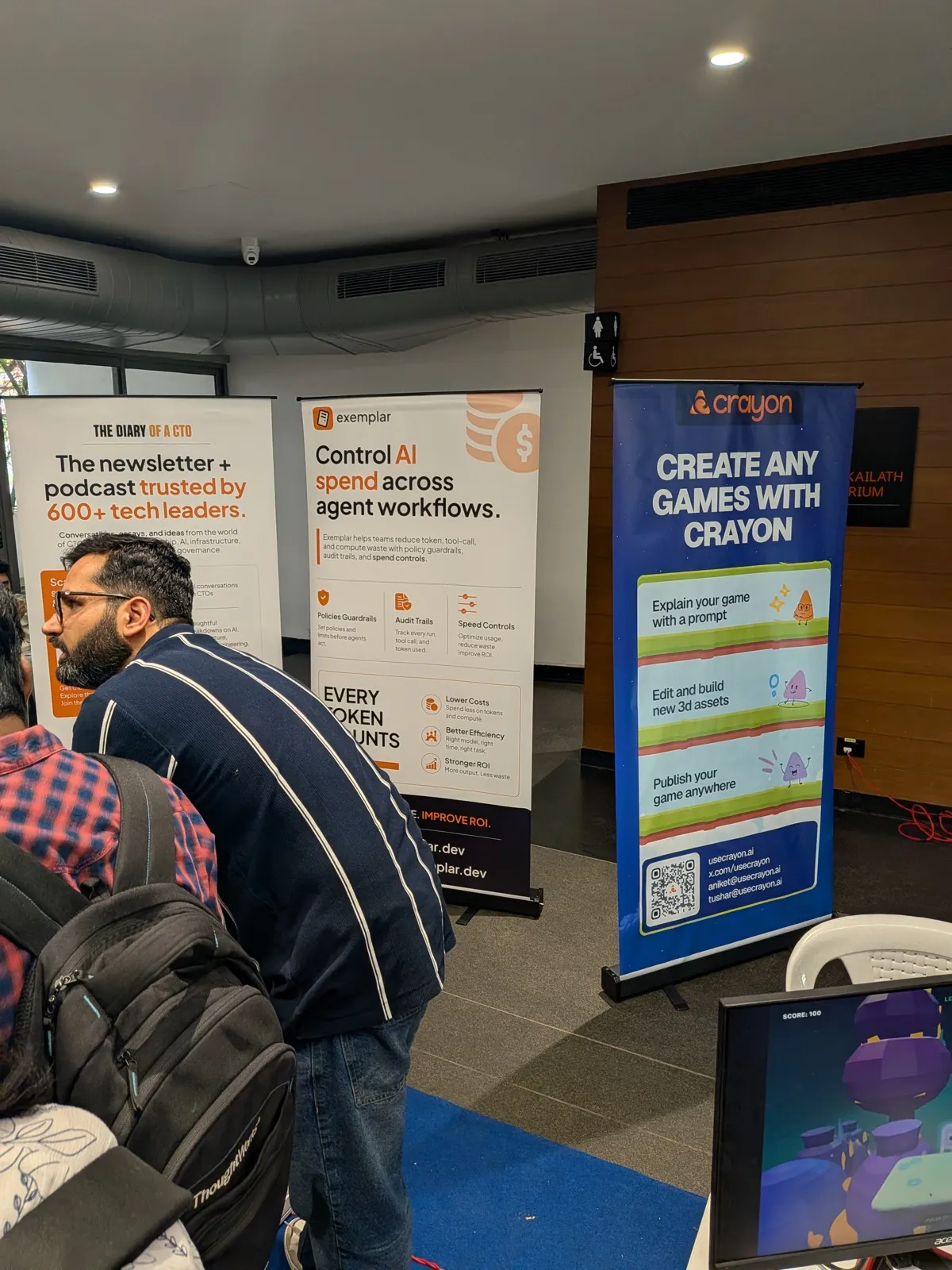
| Crayon | Playable 2D and 3D games from a text prompt — no game dev experience needed. | The rare consumer-shaped product in a room full of infrastructure. Their stage demo had a game running before the sentence finished. | usecrayon.ai |
| Velane | Integration lifecycle infrastructure for agents — discover, build, test, and promote integrations to production without leaving the chat. | Everyone builds the agent; almost nobody builds the release path for the agent’s tools. Their demo showed a test-then-publish loop in the chat window itself. | velane.sh |
| Ollive | Risk, liability and compliance for AI agents — “You have an agent but no insurance?” | Best banner at the event, and the sharpest wedge: they’re betting that AI liability becomes a line item before it becomes a lawsuit. Their staff wore “Chief AI Risk Officer” hoodies. | ollive.ai |
| Anvitra | Institutional-grade AI for financial markets — grounded, fully cited insights from news, filings and portfolio data. | “Stop investing on FOMO. Start investing on evidence.” Citation-first output is the only version of finance AI that can actually ship to a regulated desk. | anvitra.ai |
| Clawmetry | Observability and governance for AI agents — E2E encrypted, open source, no code changes. | Install via a one-line curl, tracks every prompt and tool call between your agents and the models. 123+ countries, #5 on Product Hunt per their banner. | clawmetry.com |
| Vektori | Task-specific models trained in RL environments, instead of routing everything to a frontier model. | “Stop driving your Ferrari to get groceries” is the most economically literate pitch on the floor. Their tagline — We made Sonnet 5 fail. Come watch. — is how you get people to a booth. | github.com/vektori-ai/vektori |
| Company8 | An AI application platform for simplifying complex workflows and shipping AI products faster. | Closed out the second demo block. | usedan.com |
| Exemplar | Policy guardrails, audit trails and spend controls across agent workflows — “every token counts”. | The token-burn problem is real and nobody budgets for it. Their Hindi-language poster (“Baccha hai tu mera, yeh le tokens bacha”) was the funniest thing in the building. | exemplar.dev |
| clawdlinux | Open-source (Apache 2.0) governance for AI agents on Kubernetes — auditable events for every agent action. | Agents are becoming a workload class that k8s RBAC was never designed for. Onboarding pilot customers now. | clawdlinux.org |
| Logcat | Device systems engineering: correlates crashes across kernel, driver and framework layers to a root cause in minutes. | Deeply unfashionable and deeply needed — a camera crash that starts in the HAL and surfaces as a framework ANR takes a human days. Card on the table said $2.55M raised. | logcat.ai |
| Bugb | AI-driven vulnerability discovery — “trusted by the targets themselves”, paying roughly $0.75 per find. | Per-find pricing on security research is an unusual and testable business model. Either the economics work or they very publicly don’t. | — |
| Waypoint | One API key for every agent — 42,000+ agents crawled from the wild, verified by live probe data, pay-per-call from $0.001. | “Agents that pay each other.” The most speculative bet at the summit and the most interesting if it lands: a payments-and-discovery layer for agent-to-agent commerce. | waypoint.ing |
| Waggle MCP | Local-first, graph-backed persistent memory server for agents — stores what you decided, why, and what changed. | Runs on SQLite by default, zero cloud calls, no telemetry. Solo-built by Abhigyan Shekhar and already at 7,000+ PyPI downloads. Auto-detects Claude Code, Cursor, Codex and Gemini CLI. | — |
| Kortecx | An agentic runtime — describe the unit of work and it spawns, orchestrates and manages agentic apps. Scale to zero. | Open-source core with LG, CLI and SDK interfaces. Runtime-as-a-product is a crowded category, but scale-to-zero pricing is the honest version of it. | — |
| Nasiko | Agent registry, semantic routing, guardrails and visibility — moving agents from experimentation to governed operation. | “Building agents is easy, managing them isn’t easy” is the whole 2026 thesis compressed into one line. | nasiko.com |
| VörrAI (Frigga Labs) | An infrastructure knowledge layer for the AI you already use — indexes cloud, code, deployments, monitoring and incidents, plugged in as an MCP server. | Works with Claude, ChatGPT and Cursor rather than replacing them. $39/seat/month, published on the banner, which almost nobody else did. | frigga.cloud |
| ClockNext | Pricing and billing infrastructure purpose-built for AI-native apps: credits, wallets, AI cost tracking, outcome-based billing. | Usage-based billing on non-deterministic costs is genuinely hard, and every AI company hits it in month six. | clocknext.com |
| Kelviq | Payments and billing infrastructure for AI companies. | Second billing-infra company on the floor, which tells you something about where the pain is. | — |
| Factryze | AI agents for GPU infrastructure — maximise utilisation, reduce job failure and downtime, AI-powered root cause analysis. | GPU goodput is where money is actually being burned right now. Agents debugging cluster failures is a legible, boring, valuable use case. | factryze.com |
| Trinetre Labs | Ask. Verify. Decide. Natural-language questions over company data, with a verification step on every answer. | The demo showed a Q3 revenue figure with a “Verified” badge next to it. The badge is the product. | trinetrolabs.com |
| Uncypher | “The AI analyst data teams can finally trust.” | Same trust-gap thesis as Trinetre, aimed at the data team rather than the exec. | — |
| Alan AI | A software factory for modern engineering teams — plan, code, review and ship with agents. | Positioning against the IDE-plugin crowd by claiming the whole SDLC. | tryalan.ai |
| Loomstack | Agents for engineering orgs — “What broke when you scaled AI coding?” | The question on their booth wall is the one every engineering leader is quietly asking after twelve months of Copilot. | — |
| Eidetix | “Hand it off. Release-ready comes back.” | Handoff-to-agent framing rather than pair-programming framing. A real philosophical split in this category. | — |
| gingerlabs.ai | An embedded AI agent for user-facing workflows — one agent, outcome delivered, instead of many steps and drop-offs. | Aimed at product teams fighting funnel drop-off, not at engineers. Different buyer, much shorter sales cycle. | gingerlabs.ai |
| VaaniEval | Open-source voice AI evaluator — scores voice agent runs and explains the verdict. | Voice agents are shipping fast and being evaluated by vibes. Open-source evals are the correction. | — |
| Vobiz | Telephony infrastructure for voice AI — sub-80ms latency, 3M+ minutes, SIP trunking. | The unglamorous layer under every voice agent demo. Latency is the whole product. | — |
| June | A personal AI assistant — voice-first, takes action, no interruptions. “Meet the AI worth remembering.” | Consumer assistant with memory as the differentiator. Demo showed it booking a cab from context. | — |
| Newtral | Agentic ESG and emissions compliance — “Noa does the gruntwork”, mapped to every framework. | Compliance reporting is repetitive, deadline-driven and audited. Perfect agent-shaped work. | — |
| Logimodel AI | Logistics networks on autopilot — agentic integrations, network stress-testing, predictive optimisation. | Onboarding in weeks not months is the actual sales pitch in logistics software. | — |
| Deepwork Labs | “Get your shelves right” — retail shelf and inventory planning, replacing manual guesswork. | Physical-world agents with a measurable outcome. Refreshing in a room full of dashboards. | — |
| Miraitrip / Kizuna | Curated small-group dinners — “Strangers at 7:30. Friends by dessert.” Tables of eight, verified hosts, no lurkers. | The only company at an agent summit not selling agents. Given how much of the evening was people trying to meet each other, arguably the most on-theme product there. | — |
| Zeon Games | Text prompt to playable game. | Second text-to-game company on the floor. Their whiteboard said it plainly: Type a prompt → Get a game. | — |
| AxiomCore | Booth G-14. | Signage covered by a neighbour’s poster before I got a clean photo. | — |
| Agentagon | Booth G-12. | — | — |
| Rocket Graph | Booth G-05. | — | — |
| Staso | Booth G-11. | — | — |
| Apriori | Booth F-18. | — | — |
| OpenTagAgent | Booth F-29. | — | — |
| Reticle | Booth F-30. | — | — |
| GeoAgentix | Booth F-31. | — | — |
| Rayform | Booth F-32. | — | — |
| DevRev | Booth F-05. | The one established company on the floor. | — |
Two of the tables were empty when I walked past — F-32 had a placard and nothing else — so a few of those bottom rows are a name and a grid reference and nothing more. I’d rather list them than pretend the floor was smaller than it was.
Not a startup, but worth noting: The Diary of a CTO (diaryofacto.org), a newsletter and podcast hosted by Himanshu Saxena, had a booth and claims 600+ tech leaders subscribed.
The two demo blocks
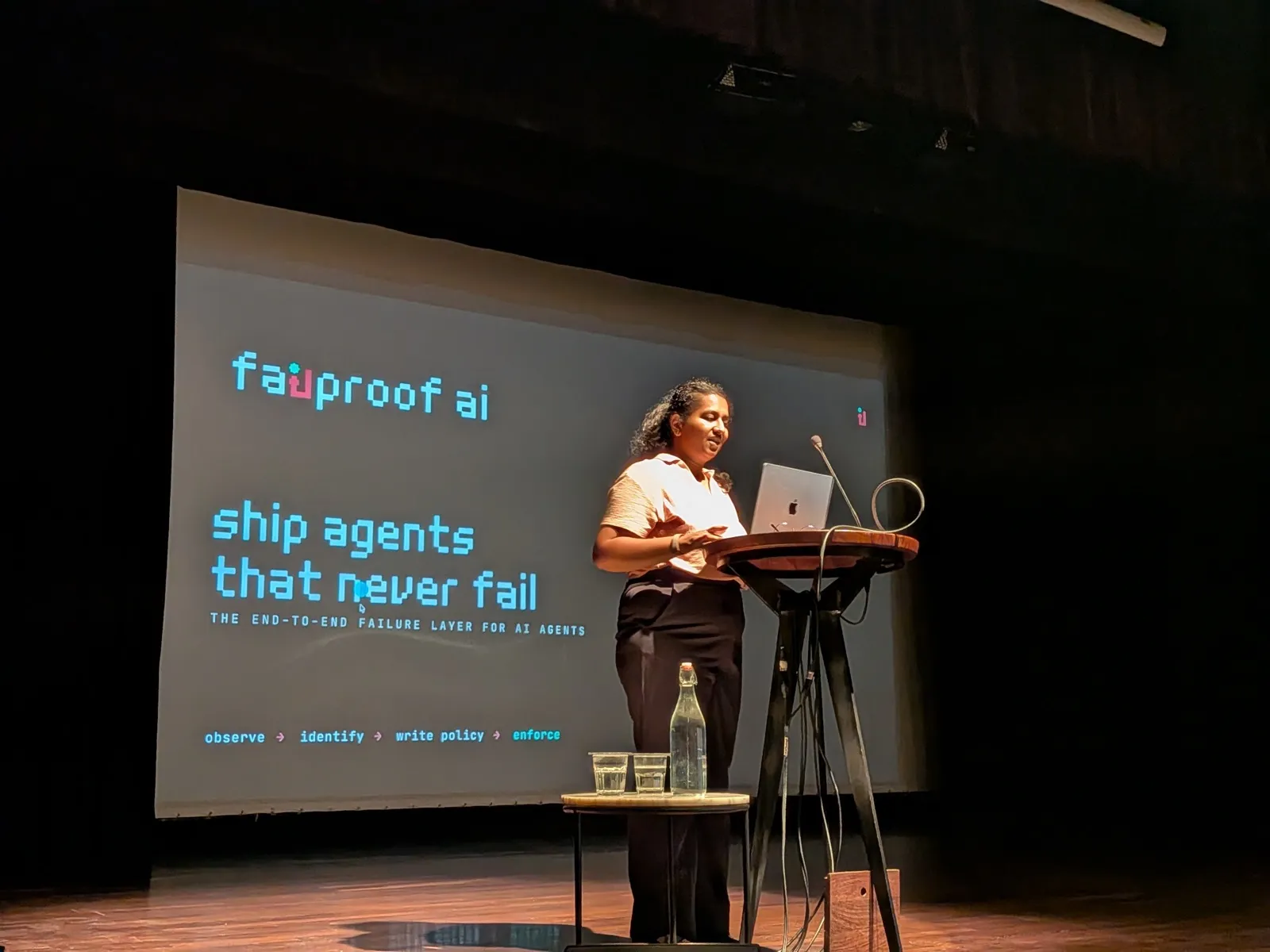
Failproof AI opened. observe → identify → write policy → enforce on the title slide, which is a real product architecture rather than a tagline, and the talk followed it.
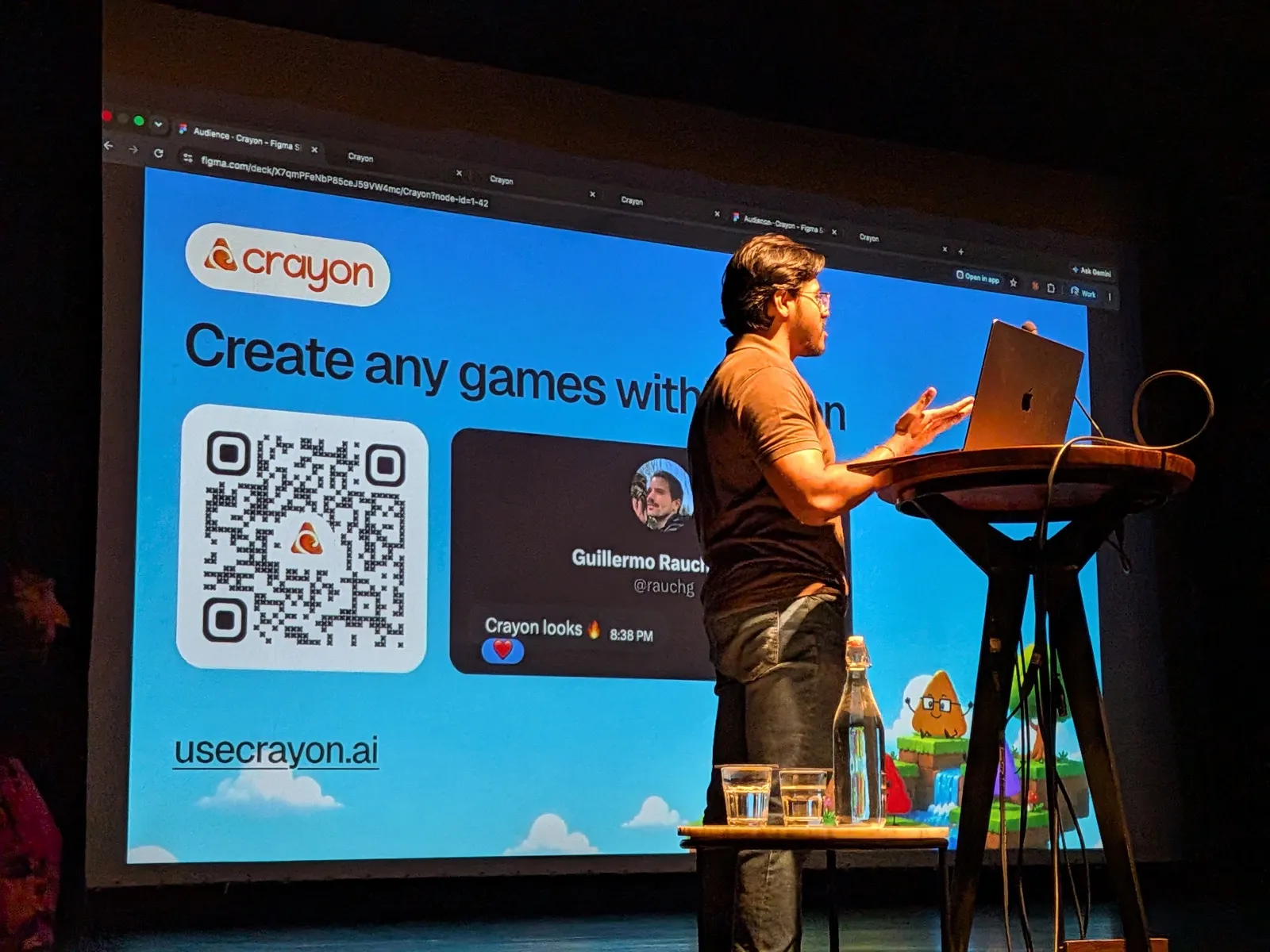
Crayon presented off a Figma deck with about nine tabs open, ran a live game generation, and dropped a Guillermo Rauch quote on the slide. It landed.
Grayscale’s SF Program
The talk I didn’t expect to find interesting was Siddharth Verma’s fifteen minutes on Grayscale Ventures’ SF Program.
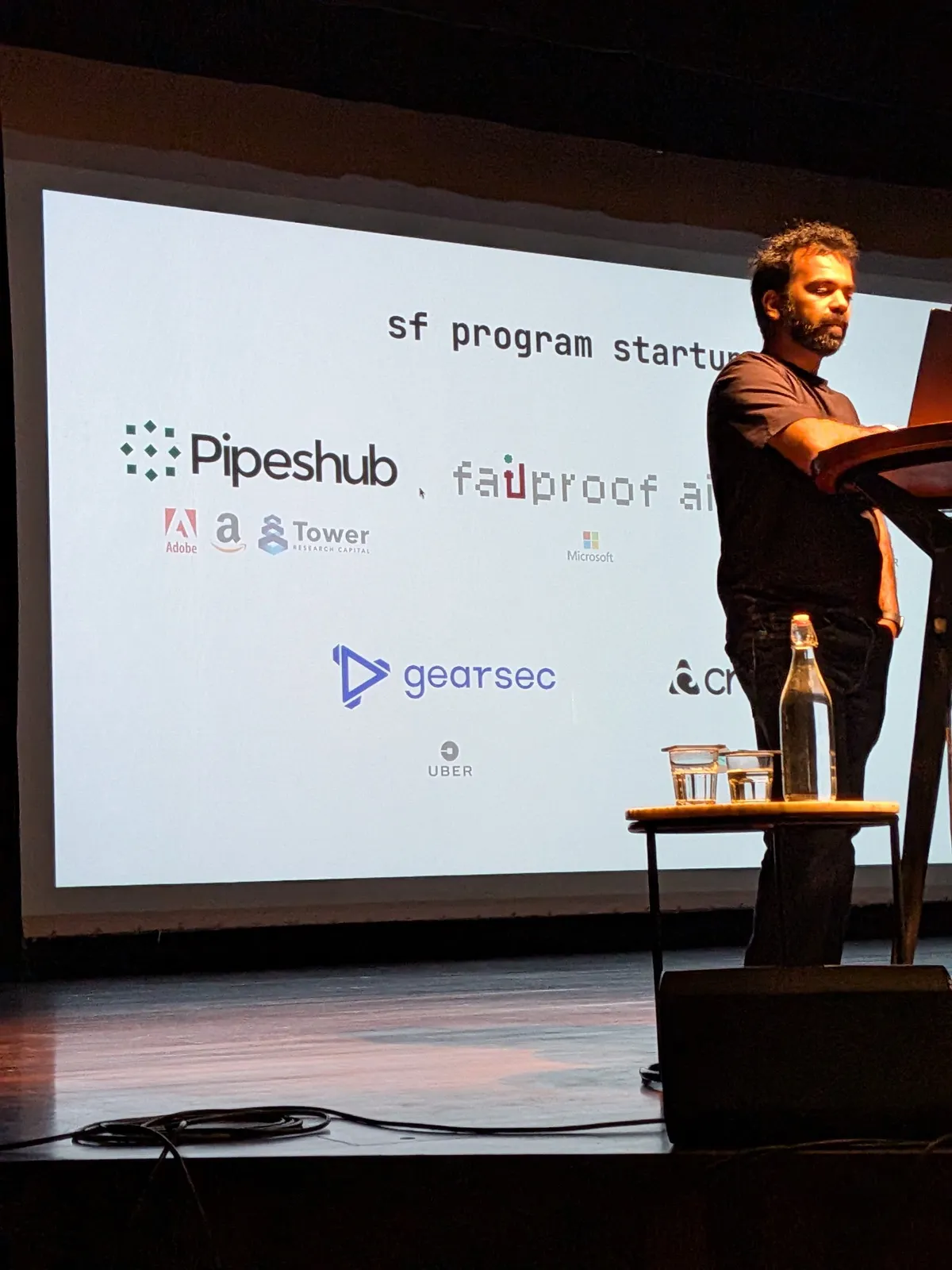
Grayscale is a Bengaluru-based, developer-infrastructure-focused fund — early cheques into Hasura, 100ms and Testsigma, one of whom was sponsoring the room we were sitting in. The SF Program does one specific thing: it puts ambitious Indian AI founders physically in San Francisco for a stretch, inside the ecosystem, next to other founders and investors.
What made the slide land was the format. It listed the startups already through the programme — Pipeshub, Failproof AI, gearsec, Crayon — and under each one, the logos of where those founders came from: Adobe, Amazon, Tower Research Capital, Microsoft, Uber. Not a pitch about the fund. A pitch about the peer group, which is the only thing an accelerator actually sells.
Two of those companies were demoing on the same stage that evening, which is a more persuasive argument than any slide. Applications are open via a Google Form — unglamorous, and appropriately so.
The book
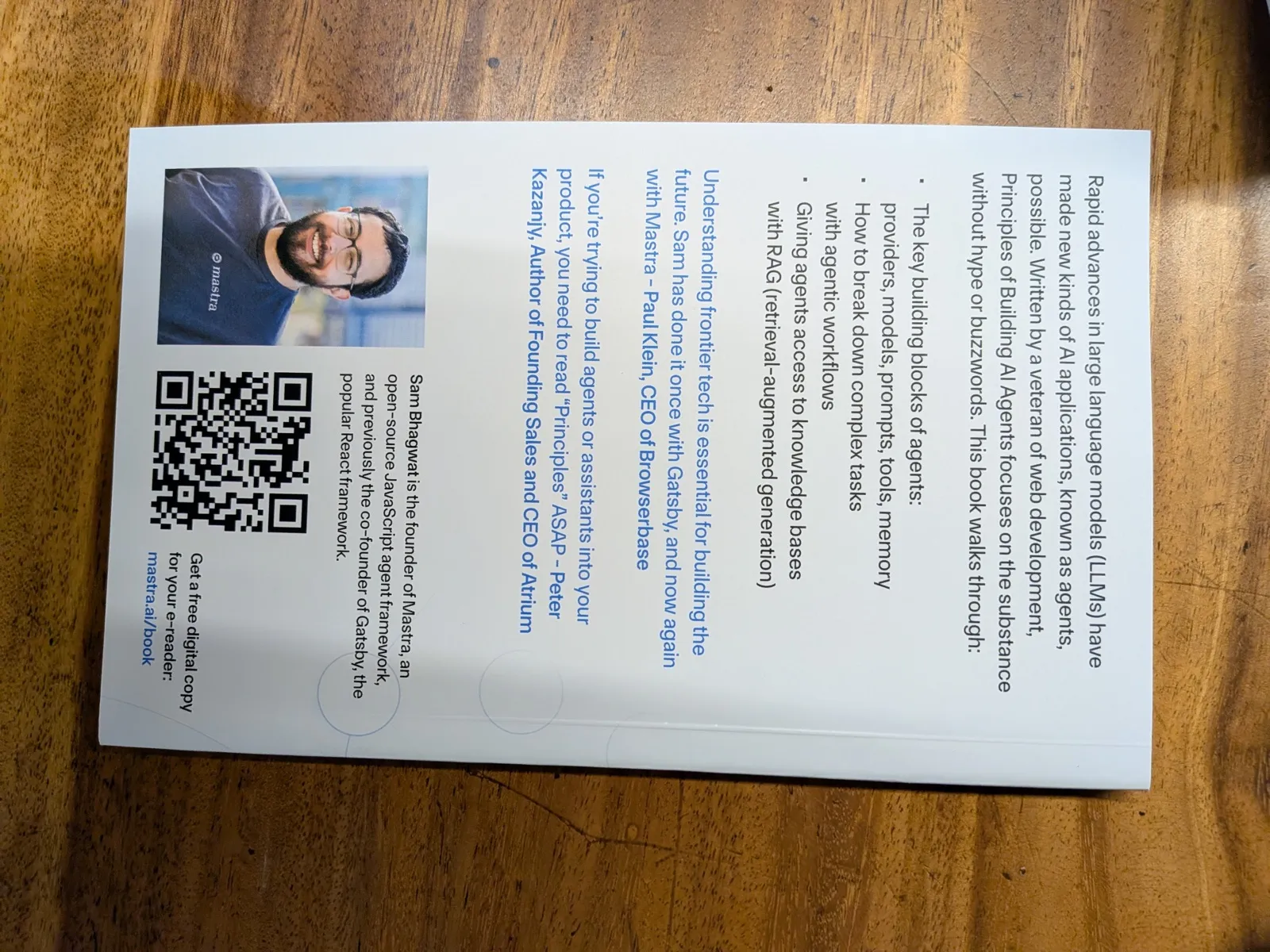
Mastra was handing out physical copies of Principles of Building AI Agents by Sam Bhagwat, their founder and CEO, and it was the single most-carried object in the building by the end of the night.
I picked one up expecting swag and got something better. The back cover promises the substance of building agents “without hype or buzzwords”, and the chapter list backs it: LLM fundamentals and prompt engineering first, then agents, tool calling, memory, workflows, RAG, and later multi-agent systems, evals, observability and deployment. Bhagwat co-founded Gatsby before Mastra, which shows — it reads like framework documentation written by someone who has had to support one.
It’s free as a PDF at mastra.ai/book, and there’s a second edition with new material on MCP, voice, A2A and computer use. The physical copy is nicer, but the content is the same and the download is one click.
Handing out a genuinely good technical book with your framework’s name on the spine is a better developer marketing strategy than any booth on that floor. It cost them a print run and it’s still sitting on my desk five days later.
What I took away
The theme of the evening wasn’t agents. It was governing agents.
I sorted all 44 booths into buckets to check whether that was a real pattern or just the three banners I happened to remember:
All 44 booths from the table above. The grey bar is the nine stands where I only got a placard and no signage — missing data, not a category. Buckets are my own; a few companies could sit in two.
It is a real pattern. The biggest bucket by a clear margin is the operational layer: policy and spend control (Exemplar), failure and reliability (Failproof), observability (Clawmetry), risk and liability (Ollive), k8s governance (clawdlinux), memory (Waggle), evals (VaaniEval), billing (ClockNext, Kelviq), registry and routing (Nasiko), payments between agents (Waypoint).
Eleven of the thirty-five booths I could classify — nearly a third — were building guardrails, meters and audit trails. Only six were selling a way to build an agent.
That ratio is the story. Eighteen months ago a room like this would have been full of agent frameworks. Now the frameworks are assumed and everyone is selling the operational layer around them — which is exactly what happens right after a technology stops being a demo and starts being something on-call at 3am.
That’s a healthier signal than any funding number.