#events #startups
Six strangers reviewed my startup. Not one said yes, and the reason I invented was wrong.
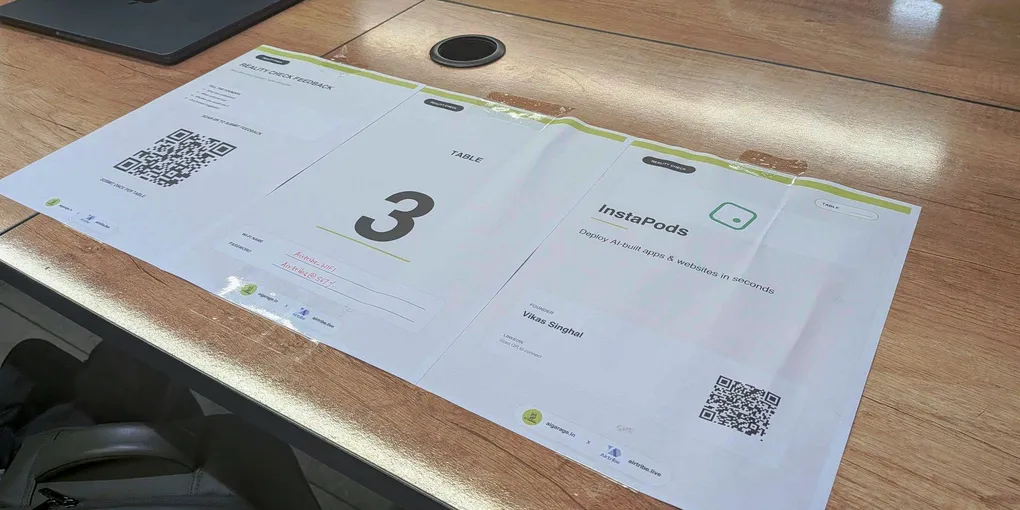
On Saturday I sat at table 3 of a thing called Reality Check, run by AI Garage with Airtribe, in Airtribe’s office in HSR Layout. Nine founders, one table each, three users at a time, eight-minute rounds. When the round ends the users get up, walk to the next table, and you do it again.
The round is scripted down to the half minute. One minute of context, three minutes of pitch or demo, two and a half minutes of the users reacting and asking questions, then ninety seconds for them to fill in a form and rotate.
The instruction that mattered most was at the bottom of the briefing email: “don’t treat this like a sales pitch”, and “please avoid over-explaining or defending the idea. Let users react first.”
I was there for InstaPods. The placard on my table said Deploy AI-built apps & websites in seconds.
Two days later the organiser mailed every founder the raw form responses, all nine products in one Google Sheet. That is a generous thing to do, and it is why this post has data in it instead of vibes. Forty-one responses came back across the nine tables. Six were mine.
I think I pitched about ten times. That is my own count, taken from memory afterwards, so treat it as the shape of the morning and not a response rate.
All six rows
Here is my entire table, in the order it was submitted. Typos are theirs.
| Time | “What do you think this product does?” | “Who do you think this is for?” | Clarity |
|---|---|---|---|
| 11:34 | “It easy for creating website and app for us(non technical members)” | “Especially me” | 3 |
| 11:35 | “its good for non tech peoples who dont know how to deploy from like claude after building web site in claude” | “nontech and tech” | 4 |
| 11:35 | “Deploys websites built in chatgpt, claude etc” | “Non tech folks” | 4 |
| 12:07 | “Similar to vercel lovable” | “developers or vibecoders” | 1 |
| 13:00 | “Hosting” | “Builders” | 3 |
| 13:03 | “It’s a vibe coder friendly deployment platform” | “for vibe codera” | 3 |
Clarity is their score out of 5. My six average 3.0, against 3.46 across all forty-one responses. My rows are inside that second number and there are only six of them, so treat the gap as decoration rather than a result.
The form also asks “would you use this?”, with Yes, Maybe, No, and “Not the target user” as the options. I got five Maybes and one “Not the target user”. Zero Yes.
On payment the six split evenly three ways: two would pay, two would use it if it were free, two would recommend it to someone else.
That is the whole record. Everything after this line is me interpreting it, and I got the first interpretation wrong.
The theory I built on the drive home
Read the middle column top to bottom and it looks like something happens at noon. Three people before twelve say non-technical. Three people after say developers, vibe coders, builders.
I had a tidy explanation ready before I got home. Non-technical people use tools like Lovable that build the app and publish it in one motion. So “deploy” is not a step they have ever performed, and not a word they have a slot for. Pitch them a deploy product and you are solving a problem they have never had.
Technical people have had the problem, get it instantly, and move straight to asking whether it survives production. Two objections, one underlying split, and my target market was the wrong half of the room.
I liked it a lot. It is also mostly not supported by the sheet.
The row that killed it
The only written mention of Lovable in my six rows is at 12:07. That respondent wrote “Similar to vercel lovable” and answered “developers or vibecoders” to who it is for.
My theory needs the Lovable comparison to come from the non-technical side. The one time it got written down, it came attached to the most technical audience guess on the table.
I had also convinced myself I could read that row closely: no capital letters, no comma between the two products, therefore this person does not experience building and deploying as separate categories. That is horoscope reading, and I did it because I already knew which answer I wanted.
The rest of the split does not hold either, once I stop wanting it to. “Vibe coder” is not the opposite of “non-technical”, it is frequently the same person. Row two answers “nontech and tech”, which belongs to both halves at once.
And the whole shape depends on the 12:07 row landing when it did. Move it half an hour earlier and there is no noon to build a story around.
Six rows in timestamp order will produce a trend if you want one badly enough. I wanted one.
What the sheet says versus what I remember
Worth separating these properly, because I had them blurred together.
From the sheet: nobody said yes. Two or three of the six clearly identified deployment as the thing being sold (“Deploys websites built in chatgpt, claude etc” and “a vibe coder friendly deployment platform”, generously “Hosting”). One heard creating rather than deploying. One did not describe the product at all, only a competitor.
Audience guesses were inconsistent and overlapping. Four of the six left “what confused you the most?” blank or filled it with “No”.
From memory, which is unrecorded and therefore not evidence: the room sorted into two kinds of question. People who seemed less technical asked how this differs from Lovable or Wix. People who seemed more technical asked whether they could trust it in production, and specifically about resiliency and snapshots.
I did not record who asked what. I did not write down a single quote at the time.
That second bucket contains the most useful thing I heard all morning, and it appears nowhere in the spreadsheet, mine or anyone’s. My first draft of this post blamed the form for that. The form asks what confused you, not what worried you, which is true but is not the reason.
The reason is that the schedule gave me two and a half minutes per round for user reactions and questions, ten times over, and I spent all of it talking instead of writing. The organiser’s form is built to capture comprehension across nine products at once. It was never going to capture my objections for me.
If you go to one of these, write your own notes in the ninety seconds while they fill in theirs.
Three things to test on the 22nd
These are not conclusions, because six responses cannot carry one. They are the experiments the morning bought me, and the next edition is on 22 August.
Fix the script, then vary one thing. The reason I cannot tell drift from audience is that I improvised every round. Same words every round, and a note of each user’s background before they sit down. Then a difference in the middle column means something.
Test whether “deploy” needs teaching. Nobody in the data objects to effort or says it looks hard. One person heard “creating” when I said deploying, and another reached straight for a builder to describe a deploy tool. So the hypothesis is that the gap is category rather than clarity.
The test: open one round by describing the moment after the AI finishes writing your app, open the next with what InstaPods does, and see which one lands.
Bring the failure story. For anyone who already deploys, the interesting demo is not one that succeeds. It is what happens when one doesn’t: the thing falls over at midnight and you restore a snapshot. I did not have that ready.
This last one rests entirely on remembered conversation, so it is the weakest of the three, and it is still the one I am most confident about.